
Candy AI Videos, Shorts & Episodes Explained: A Complete Guide
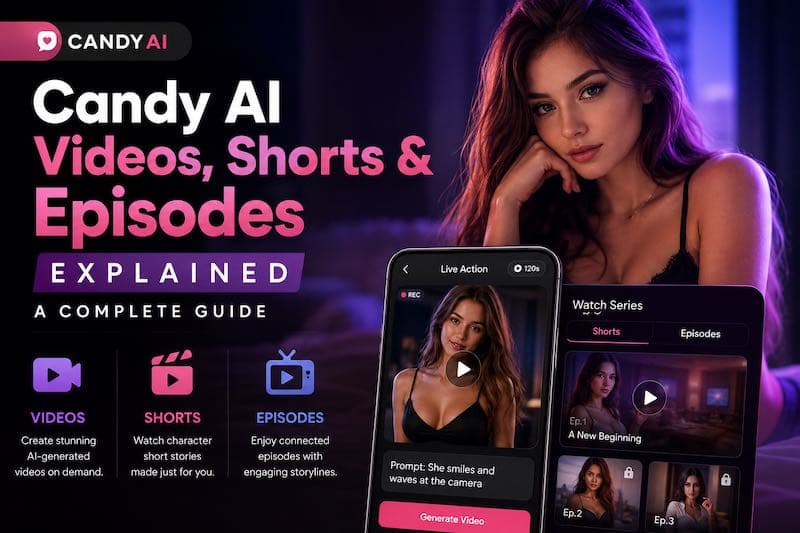
Candy AI has built three separate video experiences in addition to its regular chat, and it’s easy to lump them all together as “video generation” without realizing they work very differently. Videos, also labeled Live Action, are clips you generate yourself from a prompt. Shorts are pre-made scenes attached to a character. Episodes are just what a character’s Shorts turn into, once you follow them in order. Here’s how each one actually works, what they cost, and whether any of it is worth your tokens.
What Are Candy AI Videos, Shorts & Episodes?
Videos, or Live Action, are clips you create on demand. You write a prompt, the system generates a moving clip of your companion based on it, and it lands in your chat history. Shorts flip that around: they’re pre-produced, scripted video episodes tied to a specific character, sitting in a “Watch Series” panel on their profile. Episodes aren’t really a separate thing at all; they’re just what you get once you watch a character’s Shorts in order, a loose story arc rather than a switch you flip on.
The real difference comes down to who’s writing the scene. With Videos, that’s the user. With Shorts and Episodes, someone else already wrote it, and you’re watching, not steering.
| Feature | Who Creates It | Length | Story Continuity |
| Videos (Live Action) | You, via prompt | Up to 120 seconds | None, standalone clips |
| Shorts | Pre-produced by Candy AI | About a minute each | Loose, episode to episode |
| Episodes | Same Shorts, watched in order | Multiple minutes total | Builds across a character’s run |
Candy AI Videos: How Live Action Works
Candy Live Action is an on-demand video tool. Pick a companion, write a prompt describing an action, expression, or outfit, and it generates a clip built from that companion’s existing image model. Early versions topped out at a few seconds and they felt more like a moving photo than a video. The current one runs up to 120 seconds and tries to match the tone of what you were just talking about, not just gives out one generic loop every single time.
Customization mostly happens through the prompt itself, and whatever styling or extension options a character’s model supports. There’s no storyboard or scene editor; it’s closer to describing what you want and letting the model take a swing at it. Quality holds up well for shorter clips and gets shakier the longer or more complicated the request gets. Every generation pulls from your token balance, and longer, higher-quality clips cost more than a quick short one, though exact rates shift, so check in-app before committing to a long generation.
Candy AI Shorts & Episodes Explained
Candy AI Shorts are pre-produced video episodes tied to a specific character, tucked into a “Watch Series” panel on their profile. A typical series runs around ten episodes, each about a minute, built around that character’s backstory, not anything you typed in. New ones get flagged with a small “NEW EP” tag, the same trick every streaming app uses.
Watch more than one Short from the same character and the pattern jumps out fast. Episode one sets a scene, episode two moves it along, and by episode four or five you’re catching callbacks that only land if you saw the earlier ones. That’s really all “Episodes” means, not a separate feature but the sequence a character’s Shorts take once you follow them in order. Continuity even seeps into regular chat: bring up something from an episode and the companion will often reference it back on its own.
The first episode of any series always plays free. Everything after that is locked and gets unlocked one at a time.
Are Candy AI Shorts and Episodes Really Interactive?
Not in the branching sense, no. You can’t pick a different outcome mid-scene, and nothing about a Short changes based on what you type while it’s playing. Whatever interactivity exists lives around the content, not inside it. You pick which series to open, which episode to unlock next, and how you bring the story back into chat afterward.
That last part matters more than it sounds like it should. A companion who brings up Wednesday’s episode unprompted on Friday just feels different from a clip you watched once and forgot about. The truly responsive layer lives in Live Action, where you’re the one writing the prompt and steering the scene. There’s also a newer real-time mode reportedly rolling out in beta, letting a companion react visually during a live exchange rather than through a pre-generated clip, though how far along that beta really is depends on who you ask.
So when people refer to this as “interactive,” they mean your choices shape what you see and how it folds back into your relationship with a character. The story itself isn’t bending around your input.
How Much Do Candy AI Videos, Shorts & Episodes Cost?
All three sit behind a mix of subscription and token spending. A Premium plan is generally what unlocks the bulk of video content, with tokens spent on top for individual generations or episodes. Live Action draws from your token balance per generation, and longer or higher-quality clips cost more than short, simple ones.
Unlocking a Short or Episode past the free first one also costs tokens, spent per episode rather than as one flat unlock for the whole series. Tokens are shared across video, images, and other visual features on the platform, so going heavy on one can eat into what’s left for the others. Worth budgeting for rather than spending freely early on.
The free first episode does the real work here. It’s a full clip, instead of some stripped-down teaser, so it’s enough on its own to tell whether a character’s writing and pacing are worth paying to continue. One should try that before spending tokens on anything else video-related.
Are Candy AI Videos, Shorts & Episodes Worth It?
Video quality holds up well for shorter Live Action clips and gets less consistent as length or complexity climbs. Shorts, being pre-produced, tend to look cleaner and more consistent than what you’d generate yourself on the fly. Character consistency is generally solid within a Short’s own series, since it’s built around one character’s established look, though Live Action clips can wander more depending on your prompt.
Story quality in Shorts and Episodes is better than you’d expect from what’s basically a bonus feature: real pacing and real callbacks, not throwaway clips. This fits people who already have an ongoing relationship with a specific character and want that relationship to feel like it exists past the chat window. It is not much suitable for anyone hoping for a true choose-your-own-path video experience, since neither Videos nor Shorts branch based on what you do.
The biggest limitations are token costs adding up fast and the fact that Shorts and Episodes are fixed. You can react to them, but you can’t reshape them.
Final verdict: worth trying, especially since the first episode of any series is free, but budget your tokens before diving into a full season or a string of Live Action generations.
Conclusion
If you want full creative control over a scene, you should use Live Action and write the prompt yourself. If you want a well-made short film about a character you already talk to, you should watch their Shorts in order and let the Episodes build. And if you’re just curious whether any of this is worth your tokens at all, start with a free first episode. It’ll tell you almost everything you need to know before you spend a single token.